backchannel: first time cold weather boondocking
from this reddit post
overview
I have a brand new size 24 AGM deep cycle battery… we’d have no way to charge the battery… What am I missing, what should I be prepared for?
On this trip: I’d be prepared for the furnace blower and other 12v loads to drain the battery much sooner than expected.
In the longer term: since the AGM is brand new I suspect the old one was killed by insufficient charging and the new one will be, too. When this one dies (hopefully after long and faithful service) I’d give serious thought to replacing it with LiFePO4. They will perform better and, more importantly, are not damaged by partial states of charge.
we can drive off site and replace the propane tank. But we’d have no way to charge the battery if we run it down (that’s not exactly true, we could probably hook the truck up and run it as a generator, but that’s an extreme measure)
Charging from the alternator while driving is a common approach. The major challenge with a trailer is how to move the power from the tow vehicle to the trailer.
a robust approach to charging the house battery in the field and on the road
I am not a big fan of combo solar/DC-DC chargers, but this might be a good use case for one. It would maintain the starter battery in the tow vehicle (TV) when not camping1 and provide some field charging for the trailer’s house battery while camping.
Trading convenience for absolute performance we’ll route power through the 7pin rather than through thicker wires.
install
- procure a combo DC-DC. Since our 7pin can likely only carry ~10A on the it can be a small one.
- disconnect the 7pin’s POS wire (often black in color) from wherever it is taking power from the chassis. Connect it instead to the output of the DC-DC. This step is only necessary if you are fudging voltage upwards (see below).
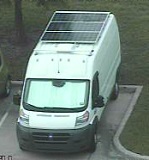
- install as much panel as can be discreetly mounted between the cargo bars on the vehicle in question. 200w would be nice. Connect to the charger.
- connect the starter battery to the charger
dealing with voltage sag
Voltage sag on the 7pin POS/GND circuit is a challenge. I’d use a voltmeter to sample voltage on the line at charger’s output and at the house battery while getting maximal charge. The difference will be the voltage sag – let’s stipulate it is 1.5v. We probably won’t have voltage sensing2 so our best bet is to set charger output to the upper limits of what the house battery chemistry will tolerate. That way when sag is minimal (bank approaching full charge) it will not see excess voltage.
We could add the 1.5v max sag number to our charging setpoint (e.g.. 14.2v + 1.5v = 15.7v but this could overcharge the bank if/when solar brings it to a full charge.
simpler solar-only charging
Adhere thin-film panels like CIGS to the teardrop’s curved roof to feed an MPPT solar charge controller.